

Making up your mind on what type of 4×4 trail to explore next usually is not that difficult, but what are the pros and cons for each of the different terrain you will encounter on your adventure. Usually the area where you live will be a huge factor on what type of terrain you drive, as the landscape differs tremendously from area to area.
When i started my 4×4 driving journey, the majority of my trails i drove was sand, as it was close to home and a easy way to learn the capabilities of my vehicle. But as your confidence in yourself and your vehicle grows the exploration needs also change. Going from sand to another terrain was a big change, i went from sand to rock trails and later mud which did not work out that great.
SAND DRIVING:
Before you head off a few things to have and to remember:
- Always take a pressure gauge along, i have one permanently in my vehicle as i do not trust the filling stations gauges.
- Make sure your vehicle has proper recovery points, your tow bar is not a recovery point.
- Make sure your tires are still in a good condition, large crack and cuts can cause problems when deflated.
- Try to not go driving alone, as you will need the help from another vehicle when getting stuck.
- Try to have a 12v 4×4 compressor in your vehicle, as you will need to inflate your tires after the trail. In the beginning i just made sure i took someone along who has one.
First things first, when you enter the area that you will be driving in, stop and deflate your tire pressure. Some people say go down straight away to 0.8bar, i do not agree with that as there is the possibility of your tires de-beading and you will have to change a wheel in the sand. My rule of thumb is to deflate from normal road pressure to around 1.2bar, i will rather get stuck or not get up a hill then having a tire de-bead. From this you can feel while driving if your vehicle is struggling or not, if you feel a struggle come to a standstill and deflate you tires more. The more you drive on sand, the better you will start to have a feeling of what pressure is suited what type of sand. Never deflate your tires below 0.8bar as you can cause damage to them.
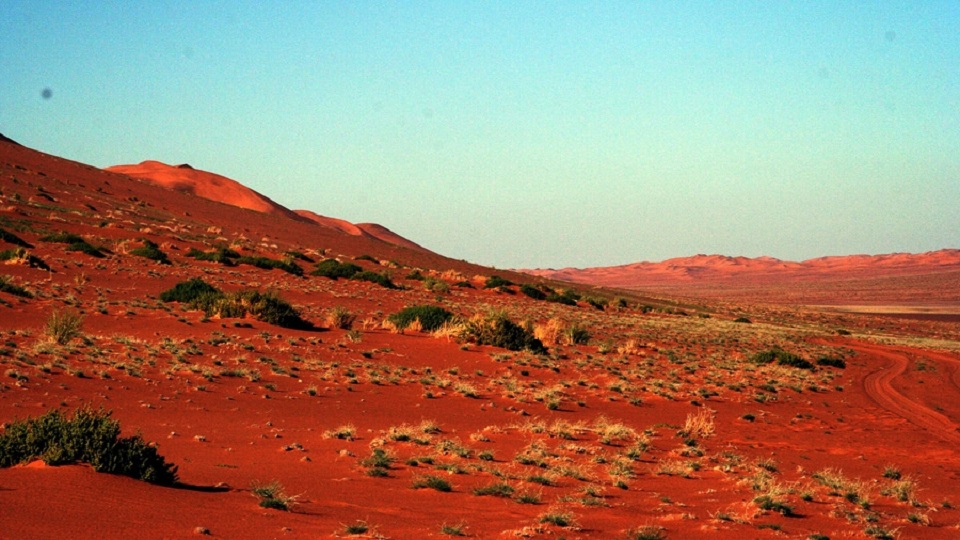
A few sand driving tips & techniques:
- Best gears to be in differ from situation to situation, but a good rule of thumb is low range and usually 2nd or 3rd gear. You need all the power you can get to the wheels without spinning in the sand. When pulling away gradually pick up speed with out spinning.
- There is no need to drive like evil kenevil, keep a nice steady speed as all you need to do is keep your momentum. Keeping a steady momentum is important, because if you lose it then it is a struggle to get it back.
- Braking in sand is not like you do on a normal road, if you use your brakes your wheels will dig in to the sand and cause trouble when trying to move again. When needing to stop try to engage your clutch and let your vehicle roll to a stop, for an automatic just leave your accelerator peddle and roll to a stop.
- When going uphill, choose your gear you need to be in and go up with a steady momentum. Going to fast may cause your vehicle to get air born, and this could cause severe damage. Try not to gear down as you go up, if you need to do it as fast as possible to minimize any wheel spin and loss of momentum.
- Going downhill needs minimum effort from your brake, make sure you are in low range and put in 1st gear. Let the vehicle roll slowly down the hill, your low range will use engine braking to slow it down. Unfortunately in a lot of the automatics your 1st gear is not low enough, gently apply your brakes without causing any sudden stops.
ROCK DRIVING:
The same applies to to rock driving as for sand driving on your things never to forgot except a few extra pointer on certain aspect of your kit.
Things to remember that is a essential need on your vehicle inside and out:
- Recovery points is more essential when doing rock trails, as in sand driving where proper on vehicle points will do when doing rock trails a rated recovery point is a must. Your effort to pull vehicles out of sticky situations will be more, and the forces you exert on the shackles will need a proper recovery point. No need for off-road bumpers etc. just a proper recovery point mounted directly to your chassis.
- On sand a proper A/T tire will do or even your H/T tires, when doing rocky routes a better A/T tire is a must. One that with a more rugged pattern and at least a 3 ply sidewall to help protect your sidewalls from cuts. I prefer a M/T tire on rock trails as it gives superior grip and allows for a lower pressure if needed without damaging the tire.
As with driving on sand you will need to drop your tire pressure, you will not deflate it as much as with sand driving. I have learnt from my experience as a rule of thumb to deflate it to at least 1.2bar as a start. As you continue with your trail and are struggling with grip you can lower it to 1.0bar. On most proper A/T 1.2bar will do the trick, but if you are running a M/T tire you will be able to go as low as 0.8bar. The M/T tires usually have a far more robust sidewall that allows for lower tire pressure.
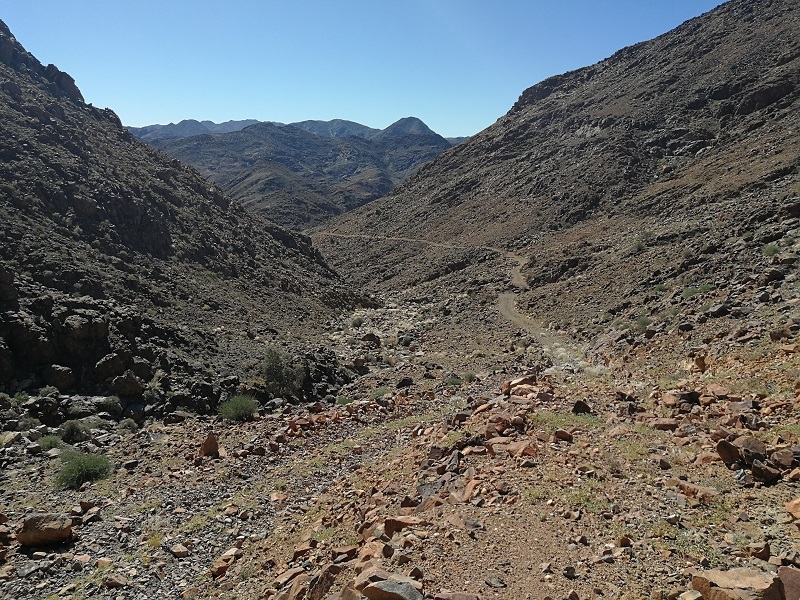
A few rock driving tips & techniques:
- Gear selection will depend on the difficulty of the terrain you are attempting to cross. Faster driving with little amount of rock outcrops or sharp edges will be doable in High-Range in 2nd to 3rd gear. More difficult terrain needing slow driving with more boulders to cross will be best done in Low-Range in 1st or 2nd gear.
- There is no need to drive fast while driving on a rocky trail, slower is better. It will give you more time to scout the road in front of you while driving and your reaction time is much better in need of emergency or fast stopping.
- Braking is an essential factor on rock driving, especially when going downhill. Uphill breaking will be as normal, but downhill is a bit different on steep declines as there is always the possibility of losing traction and sliding down when your brakes lock.
- When going uphill the degree of the incline will play a part in gear selection, as well as the terrain. For normal uphills where traction will be good, Low-Range 1st or 2nd gear will work. Be sure to get your momentum up and keep it there. If your vehicle has a diff-lock you may engage it to help with any slips that occur. For steeper inclines where your traction will be limited, Low-Range 1st gear will be the best. If your vehicle has a diff-lock, engage it to help with the wheel spin that will occur, try to keep your momentum to a steady pace and allow your drive train and diff-lock to help you. Only brake when needed, or when the vehicle stalls.
- Going downhill will always need Low-Range 1st gear, to help you crawl down with the help of engine braking.Some of the newer vehicles has a nice function that enables crawl mode. I reckon that is a massive benefit that they have. Going downhill allow the vehicle to crawl down slowly, keep your foot on the brake lightly you only want the pads to feel the discs. Keeping it there also gives you the advantage of needing to apply it in an emergency. On your first outing driving a rocky route, you might be hesitant on the downhill as some of them can be steep. Relax and allow the vehicle to do most of the work.
What i have learnt from my experiences driving rocky trails is just to relax and take your time. You do not have to be in a hurry, and get out of your vehicle sometimes to get a general feeling of a obstacle you are about to take on. Get someone as a passenger to go along, and use him/her as a spotter. With time you confidence will grow and you will be even more relaxed.
The world is out there to explore. Life itself is a big adventure, make it an even bigger one with your travelling.
YOU ONLY LIVE ONCE, LIVE IT TO THE FULLEST…..
Feel free to share and comment. Or pop us an email with any related queries.