Since the last article my mind has been crunching with ideas and stories to share, to such a manner where I do not know as to where to start or what to talk about. Then I thought, let me plan a day out to pull some green monsters from the kayak in some local farm dams to get some footage, and find inspiration as to where to start but then it hit me! People out there that are keen to try out a kayak for the first time might have a load of concerns and questions. To such a manner where they are almost scared to get on a plastic boat for their first adventure. This article will cover some key concerns and possible questions you might have before getting out there with a kayak.
First contact
So, the first time you see a kayak you might think this is pretty awesome!
Then, as soon as you get closer and start to look at the thing you might start
having second thoughts about it. You now wonder where your gear will go and
will everything get wet or even worse, you might think that you will fall over
or lose some of your precious gear in the process.
To a great extent all those dreaded fears can very easily become reality, but by following some basics you as well as all your gear will be absolutely fine.
Stability
This is probably the most worried
about topic when it comes to kayaks. It’s the single main reason that people
would rather stand on the bank rather than sit on top of a plastic boat over a
body of water. In general, when you own a kayak or find yourself in the
vicinity of a kayak that someone offers you to use, it would most likely be a
general purpose recreational sit on top plastic kayak. All of these are great
all rounders and will most certainly serve the purpose of bass fishing in a
farm dam or even slightly bigger waters. They are all generally between 70 to 80cm
wide with bit of a semi-keeled hull, but still mostly flat, which gives it very
good stability on the water. I can guarantee you that when paddling in a dam
after some monster bass, you will not just spontaneously fall over into the
water. The only way that will happen is by free will when you are feeling hot
and want to take a dip on a summer’s day.
Gear setup
The next thing people are concerned about is, where to pack their stuff and
will their items be safe and dry on the boat. There are a few tricks to the
trade that will help keeping gear safely on the boat. Generally, you would want
to keep all valuables within the hull of the kayak as it is the most waterproof
area on your boat. Personally I keep my wallet and car keys in the “dry hatch”
towards the back of the boat as this is a hatch that I would not use very
often.
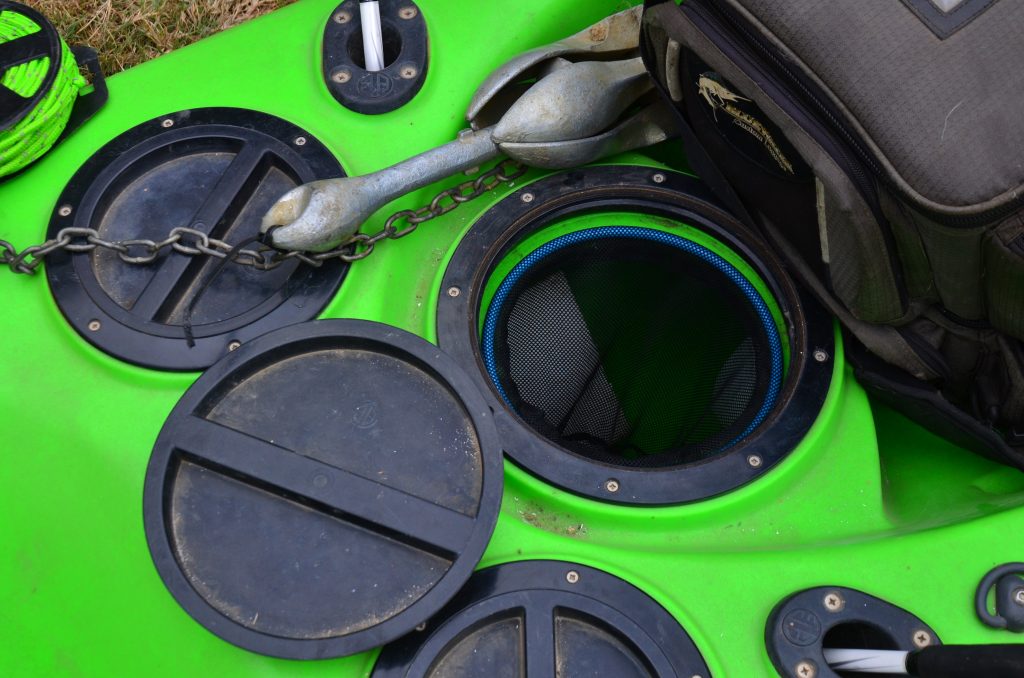
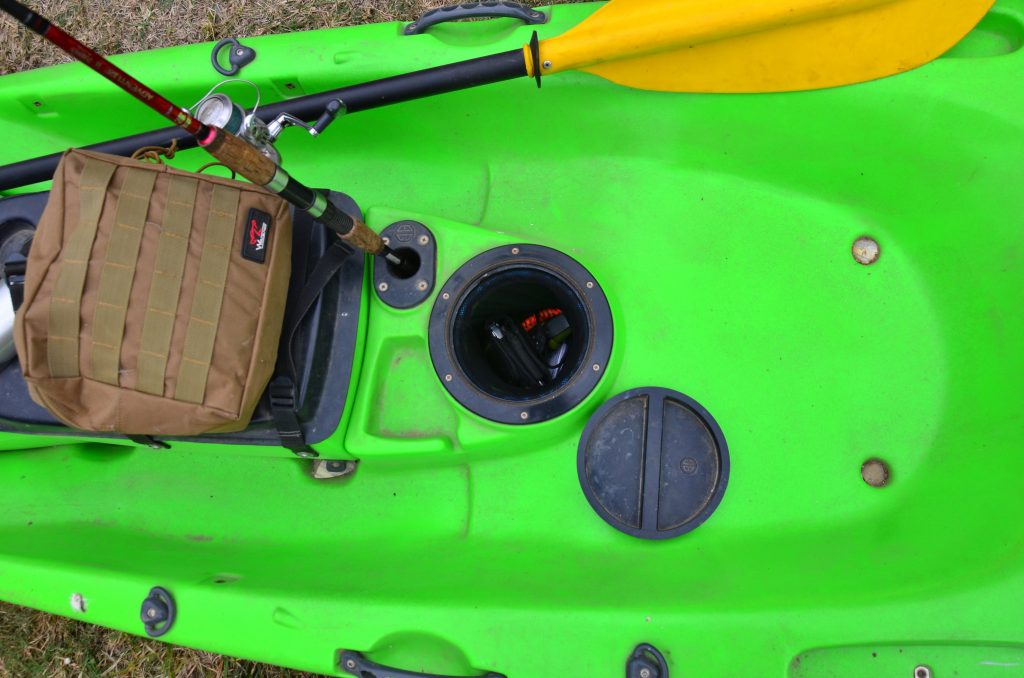
When it comes to items that I would want to use on a constant basis, for example my multi-tool to remove a stubborn treble hook from a bass or my cell phone and action camera, I would keep these in the small hatch located between the foot wells towards the front of the kayak. Make sure on your kayak you find a hatch that is easy to reach and accessible with only one hand, as there will be times you would want to still hold onto a rod with a fighting fish or while you are lipping a bass and want to grab the phone for a snapshot. This will be the most used hatch on your kayak during a day on the water. Usually on a kayak the hatches have a sort of netting on the inside that helps keep your stuff together instead of everything rolling around within the hull of your kayak.
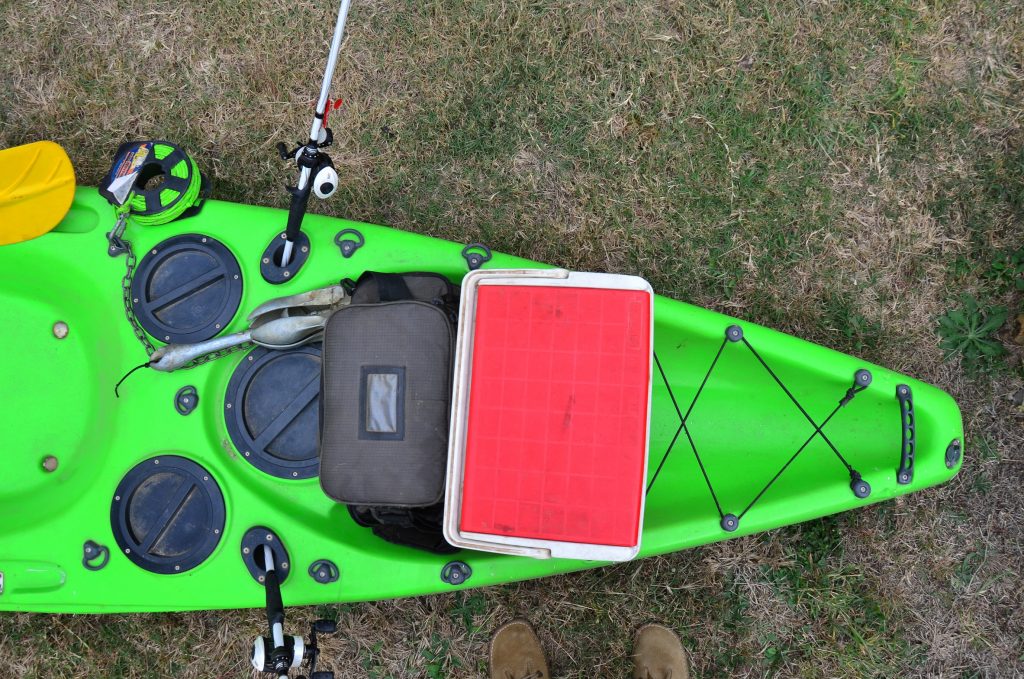
Moving onto your fishing gear. What I have found during all the hours spent on the water is that before I leave the bank, I strategize a plan of action as to what baits I will be using initially, and for the next hour or two. These baits should be readily available should you want to change your lure or try a different colour and to make life easier, I found myself a little canvas bag with a zip that I just throw on top of the deck of the kayak, towards the front where I can still easily reach it. Here I will keep one or two extra hooks, and most plastic baits that I might need to cover a whole lot of scenarios that might present itself. This “drop” bag if you will can be strapped to the deck. If your kayak has bungee cords just stuff the bag underneath them to hold it down as you paddle and manoeuvre across the dam and structures. Then, if you want to – especially on big bodies of water – load your fishing bag that contains the rest of your kit on the back of the kayak. You can also keep it down with bungee cords or by means of a tie down strap around the hull of the kayak. If the kayak has it, make use of the D-loops on the deck and strap it into position. My bag usually goes right behind my back as I make use of it on rare occasions. Another item that you can consider for those longer days out on the water is a cooler box or bag. This can also be strapped at the back of your kayak to keep your refreshments at the ready for whenever you need them.
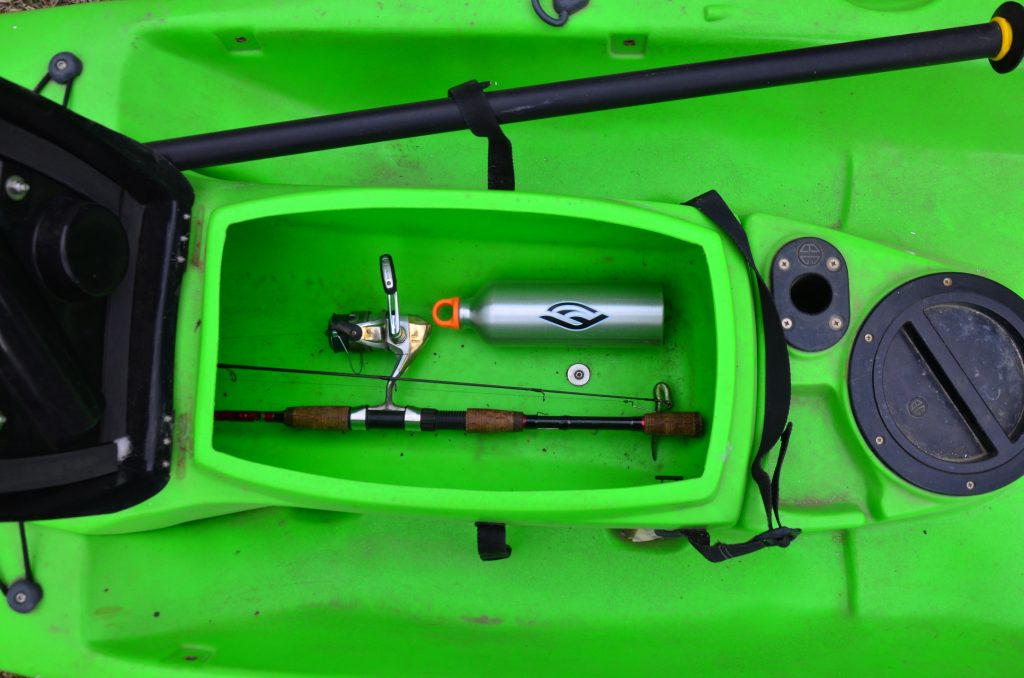
The next thing you need to keep track of is your rods and reels. I won’t recommend having more than three rods on your kayak. Casting space becomes an issue, and when you lay them flat on the deck it becomes a challenge when fishing in thick reeds or grass sections especially with longer rods. If you have a fishing kayak or climb onto a fishing kayak you will notice two flush mounted rod holders towards the back of the kayak and sometimes one or two rod holders towards the front of the kayak. Personally, I use two casting setups and one spinning rig on my kayak – I tend to keep the spinning rod a two piece and neatly tucked away within the hull of my boat where I can still access it, should I want to work some finesse baits weightless. The two casting setups will be in the rod holders out towards the back of the boat where they will be out of the way while paddling. When fishing I use the rod on the right hand side as I cast right handed and it ensures the space behind that side is open and nothing can get snagged while I’m casting. Also, I set up the casting rigs with different bait types before I leave the bank. One would have a crank or spinner and the other would have a plastic along with a weight.
You are left with the general items such as anchor or extra clothes and the paddle. If you do have an anchor I would recommend that you make use of a carabineer clip to keep the rope clipped to your boat and the anchor to be behind you where it is easily reached. Some kayaks on the market come with an anchor trolley system on the side of the kayak which can be used to align yourself with reference to the wind direction. It ensures that you are always ready to find that spot you are working hard with your favourite bait. If you do not have access to an anchor, it is not the end of the world. Read the wind and work smart as to drift into position or over a drop off or hole you have identified. If there are some reeds around, you can use them to tie your boat to a spot and fish from there or just park on top of a grass patch. The drag between kayak hull and grass would usually keep you in place for low to medium wind conditions. The paddle can be slid under the bungee cords towards the front of the kayak. Some kayaks have a dedicated groove or lip on the side of the kayak where you can neatly tuck the paddle away and lock it into place with a bungee cord latch. I personally would recommend keeping the paddle on your lap so that it’s at the ready should you need to turn the kayak while fighting a fish. You will then be able to do so with one hand while still holding the rod. On colder or winter days I also tend to keep myself a windbreaker or waterproof jacket within the hull of the kayak for that just in case moments. In part two we will look at scupper holes and transporting your kayak. Until then, have fun out there!